Integrated Annual Report 2025-26


Responsibility beneath progress

As an engineering-led manufacturing company, we recognize the environmental implications of industrial growth and continue to embed cleaner technologies, resource efficiency and circular practices into our operating model. Our approach is guided by the need to reduce carbon intensity, conserve natural resources, improve process efficiency and build a planet-positive future. This is reflected in our transition to renewable energy and other resources, smarter water systems, Zero Liquid Discharge facilities and stronger waste recovery practices.
Material topics linked
M2
M3
Risks Linked
R2
UN SDGs Linked


Reducing greenhouse emissions
We are continually taking measures to reduce our carbon emissions and thereby decarbonize our operations. Adoption of renewable energy is an important step towards this. In FY2026, 38.02% of the electricity consumption was from renewable source, 1,15,797 MWh from solar energy and 32,183 MWh from wind energy.
During FY2026, we undertook a comprehensive set of energy efficiency initiatives across our manufacturing ecosystem, reinforcing our commitment to sustainable growth. By embedding automation, real-time control logic, and eliminating idle energy consumption across machines and utilities, we have enhanced both performance and efficiency. Our efforts in furnace optimization, reduction of thermal losses, and elimination of redundant energy-intensive equipment further contributed to improving overall energy productivity. Through a balanced approach of combining advanced technologies and operational discipline, we optimized critical utilities such as compressed air systems and cooling infrastructure, while scaling the adoption of high-efficiency solutions including heat pumps and Variable Frequency Drives. This helped in reducing the energy consumption to the extent of 4,743 MWh and reduction of carbon dioxide emissions by 3,367 tons.
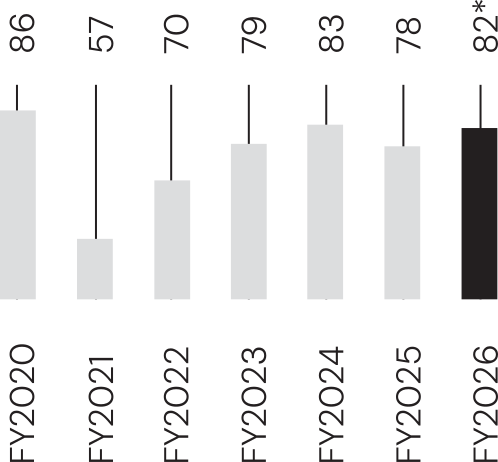
Use of alternate fuels in the furnace operations because of scarcity in gas in Q4FY2025-26 has led to a minor increase in scope 1 greenhouse gas (GHG) emissions.
Scope 1 emissions (thousand tCO₂e)
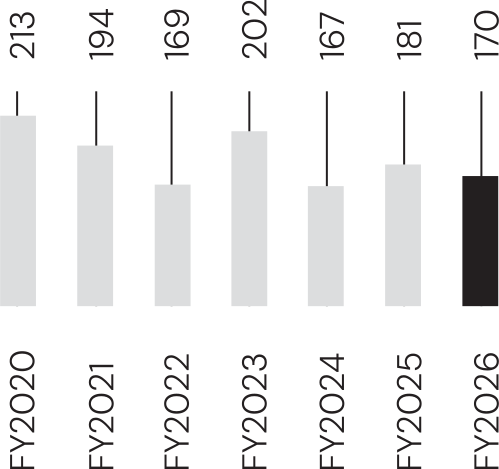
Scope 2 emissions (thousand tCO₂e)
*FY2026 saw one-time spike due to use of alternate fuels.
Actions identified as part of Climate Risk Assessment were taken up for implementation across all plants of Bharat Forge. We have mapped our operational carbon footprint, which helped us in defining the emission reduction targets. Near term GHG emission reduction targets are approved by SBTi. In line with SBTi, we will reduce Scope 1, Scope 2, & Scope 3 emissions by 54.6% by FY2033 as compared to baseline year FY2020.
Ensuring zero liquid discharge
Water stewardship remains central to our natural capital strategy. We focus on reducing freshwater consumption, improving water efficiency and strengthening reuse through advanced treatment systems and digital monitoring.
We have formulated a water management system and are undertaking multiple efforts to effectively control the industrial wastewater generated by our activities. Water consumption monitoring was done the entire year through digital meters and IoT platforms. Monitoring water consumption on real-time basis helped in reducing the freshwater intake. Actions identified as part of water risk assessment were taken up for implementation in our operations. Implementation of these actions would help in achieving our target of becoming water positive by 2030. Almost half of our water consumption was fulfilled through recycled sources in FY2026.
Our manufacturing facilities have Effluent Treatment Plants (ETP) and Sewage Treatment Plant (STP), as a ZLD company, we ensure no discharge of waste or treated water from our factory premises. All treated water is recycled efficiently and used for our operations to reduce freshwater consumption.
49%
Water sourced from recycled sources
Waste management
Our waste management approach is anchored in the principles of reduce, reuse and recycle, supported by circular economy practices across manufacturing and allied operations. We focus on minimizing hazardous and non-hazardous waste at source, improving segregation, strengthening recovery and diverting waste from landfill. We practice mapping waste generation and disposal methods to better understand our waste profile and take necessary actions. In FY2026, we recycled 99.27% of the total waste generated in the operations. We recycle and re-use the entire metal scrap generated in our process.
Hazardous waste is handled in strict compliance with MPCB norms and routed only through authorized agencies for safe storage, transport, recycling and disposal.
We initiated recycling of waste oil via a change in disposal pathway to limit the quantity of hazardous waste and ETP sludge thereby reducing the disposal to landfills. This would help us in achieving our target of Zero Waste to Landfill by 2030. Further, all hazardous waste is handled as per MPCB regulations, and they are sent to relevant authorized agencies for proper treatment.
Waste audits, monthly dashboards and authorized handler assessments further strengthen traceability, compliance and our progress towards Zero Waste to Landfill.
38%
Electricity sourced from renewable sources
| Particulars | FY2025 | FY2026 | Change (%) |
|---|---|---|---|
| Energy Consumption (GJ) | 2,697,120 | 2,769,853 | 2.69  |
| Scope 1 & 2 Emission Intensity (tCO₂e / MT production) | 0.998 | 1.063 | 5.61 |
| Scope 1 & 2 GHG Emission (Thousand tCO₂e) | 259 | 253 | 2.32  |
| % Renewable Energy of Total Electricity Consumed | 37.16% | 38.02% | 2.31  |
| Non-Hazardous Waste (Kg per MT of production) | 405.95 | 409.22 | 0.80 |
| Hazardous Waste (Kg per MT of production) | 5.52 | 5.23 | 5.25 |
| Specific Water Consumption (KL/MT Production) | 3.81 | 3.63 | 4.72 |
| % Recycle of Water of Total Water Consumption | 40.84% | 49.34% | 20.81 |
| Wastewater Discharge (m³/day) | 0 | 0 | 0.00 – |
| LTIFR (Lost Time Injury Frequency Rate) | 0.44 | 0.57 | 29.55 |
| Use of Secondary Raw Material | 41% | 36% | 12.20  |