×

ENVIRONMENTAL, SOCIAL AND GOVERNANCE (ESG)

Committed to a sustainable future

SUSTAINABILITY FRAMEWORK

Our sustainability framework forms the foundation of our approach, guiding our actions to address material risks and opportunities that impact our customers, investors, employees, value chain partners, and the communities in which we operate. This framework underpins our commitment to sustainability and drives our continuous evolution towards best practices and solutions. We have adopted a top-down approach to embed the values of sustainability across our operations, ensuring that our commitment permeates every level of our organization.

We’ve pledged to become leaders in ESG within the manufacturing sector – a bold ambition powered by a clear purpose. This belief drives our ESG mission and fuels our sustainability initiatives and investments. To mainstream ESG into our operations, we have set ambitious targets and developed a robust decarbonization roadmap. An ESG Committee, led by our Executive-cum-Joint Managing Director, ensures oversight and guidance, reinforcing our dedication to creating a sustainable future.

Sustainability lies at the heart of our operations. We have integrated ESG into our business strategy, set ambitious goals and deployed practices to create a positive impact on our planet, people, and communities. Our well-defined ESG/Sustainability framework drives us to achieve excellence in our endeavors while building a better tomorrow for everyone.

POSITIVE SHIFT IN ESG RATINGS

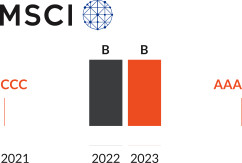
The Company understands well that ESG is about assessing the impact of environmental, social and governance issues on a company’s performance. Also, every rating agency has its own definition of what it considers those issues to be. Bharat Forge took cue from this and started working on various aspects of ESG. This helped Bharat Forge to change its narrative around ESG and improve the ratings.

Careful consideration of the requirements in the questionnaire used by different agencies to do the ESG assessments has provided insights on the disclosures that need to be made by the Company.

Specific efforts were made to improve the ESG ratings and ensure our priorities are aligned with the priorities of our customers and investors. To demonstrate the Company’s focus towards ensuring a sustainable business, ESG committee was formed at the Board level. The Committee provided directions and guidance to draft the ESG strategy and roadmap. Since then, ESG mandates are factored in all decisions including investments made by the Company. A gap analysis against its peers helped the Company to identify the areas which need to be focused on short term as well as long term. Materiality assessment supplemented the efforts made as part of the gap analysis.

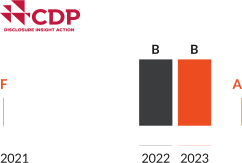
In the CDP (Carbon Disclosure Project) Assessment, the Company was at ‘F’ in 2021. Prompt disclosures were made around the mechanisms deployed in the system to monitor the energy consumption and the energy efficiency projects taken up year-on-year. Also, actions such as mapping of carbon footprint for the organization and the commitment made to Science Based Targets Initiative (SBTi) to reduce near-term emissions strengthened the aspect of climate strategy. The Company was reporting the direct and indirect emissions earlier, which then included the Scope 3 emissions in the assessments. This helped the Company to gain ‘B’ rating in 2023 and proved that Bharat Forge is truly concerned about climate change and keen on actions around climate mitigation and adaptation.

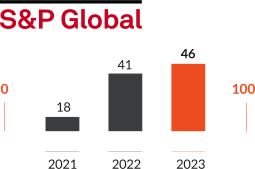
In the S&P Global Assessment, the Company had a rating of ‘18’ in 2021. Again, prompt disclosure of the existing policies and practices around regulatory compliances, environmental initiatives, human rights compliance, human capital development, health and safety helped it to move to ‘41’ in 2022. The Company continued with the actions such as framing of missing policies, revamped its risk management framework and focused on supply chain sustainability. This helped the Company to improve its score to ‘46’ in 2023.

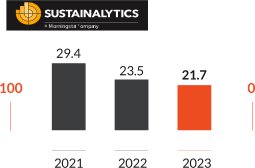
Publishing GRI-based Sustainability Reports for the Company three years in a row since FY2021 ensures that interested stakeholders are made aware of the initiatives taken by the Company around sustainability. While the report published in FY2021 was not assured by a third party agency, the reports published in the subsequent financial years were assured by third party agency. This helped in improving the Sustainalytics rating of the Company from ‘29’ in FY2021 to ’21.7’ in FY2023.

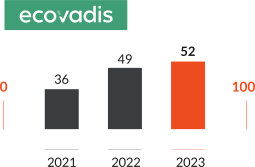
Focus was maintained towards supply chain sustainability and initiatives such as revision of Supplier Code of Conduct and general terms & conditions, and supplier sustainability assessments. This helped the Company to move from a score of ‘37’ in 2021 to ‘52’ in 2023 in the EcoVadis assessments.
ESG GOALS

Environmental


Improving Resource Efficiency

  • 80% of electrical energy to be renewable by 2030
  • 60% reduction in energy intensity by 2030
  • 40% absolute reduction in freshwater consumption by 2030
  • 60% recycled water use by 2030
  • Water positive by 2030
  • Zero waste to landfill by 2030

Reducing Emissions & Waste

  • 50% lesser Scope 1 & 2 emissions by 2030
  • 30% lesser Scope 3 emissions by 2030
  • 50% waste intensity by 2030
  • 50% secondary raw material by 2030
  • Carbon neutral in operations by 2040

Social


Growing Human Capital

  • >75% in employee engagement by 2030
  • 75% reduction in lost time incidence frequency rate by 2030
  • 20% women in managerial & leadership positions

Engaging Business Partners

  • Ensuring ESG practices at suppliers by 2030
  • 50% RE use by top suppliers by 2030
  • PCF for mainstream products by 2030
  • 30% lesser CO2 in/unit by 2030

Giving Back to Communities

  • Plant 1 million trees by 2030
  • 100 green villages by 2030
  • Contribute to education & skill development

Governance


Compliance to Ethics

  • Deployment of business ethics policies
  • 100% of employees trained on business ethics policy

Good Governance

  • Robust compliance management system and 100% compliance
  • Ensure effective data privacy management

Note: 2019 is considered as baseline year

SUSTAINABILITY CONTRIBUTIONS TO UN SDGs

Environmental


  • Progress towards low carbon economy by enhancing the share of renewable energy, conversion to cleaner fuels, and by achieving energy efficiency in operations
  • ISO 50001:2018 Energy Management system implemented in all sites
  • Estimated the GHG emissions from operations and identified actions to reduce them further
  • Improving resource efficiency by focusing on reduce, recycle, and reuse principle. Increased the use of secondary raw materials in the process
  • Reducing waste generation, disposing of them effectively and moving towards the aim of achieving Zero Waste to Landfill
  • Monitoring and controlling water consumption through the existing water management system. This helps in reducing freshwater consumption, increasing the use of recycled water, and will support us in achieving water positivity in the coming years

Social


  • Deployment of best practices towards employee health and safety to reduce workplace incidents
  • Train employees on emerging technologies and enable them to understand advanced engineering concepts
  • Human Rights due diligence check in the operations to ensure compliance with human rights
  • Established a strong connection with the suppliers on their commitment towards our Supplier code of conduct and supplier self-assessments on sustainability
  • Sustained engagement with customers through digital platforms and team visits to deliver on new product development needs
  • Undertaking holistic development in 100 villages covering areas of water availability, livelihood opportunities, enhancing healthcare, promoting education and creating infrastructure. Six of these villages have been assessed and certified as ‘Green Villages’ by an external agency.
  • Undertaken programs on education and skill development for youth, women, and farmers to empower them

Governance


  • Conformance to ethical practices and regulatory requirements with no instances of non-compliance. Maintained our track record of being a trusted organization
  • Ensured high standards of governance and accountability; submitted BRSR report to SEBI, published GRI-based Sustainability Report and inputs as part of Integrated Annual Reports
  • Driving innovation and technology for good that includes lightweighting of automobile components to increase fuel-efficiency
  • Developing e-mobility solutions for cleaner transport, and Industry 4.0-led innovative technologies to increase plant productivity
  • Implementation of robust cyber security practices to ensure protection of customer data and our assets
  • Ensuring job creation and economic growth in our operational regions
  • Materiality Assessment (Double Materiality) to review the existing Material ESG issues and the ESG Roadmap