Journey to Digital
In a world of unprecedented and constant technological disruption, our direction for growth always revolved around transformation of processes, technology, innovation, and unlocking of new opportunities, to drive new growth and deliver new efficiencies.
As we embark upon another journey towards digital transformation, let’s take a moment to dwell upon the progress achieved by the previous transformation undertaken.
The journey has not been a smooth one, but one with lots of turmoil like the 1997 domestic CV collapse, 2008 global financial crisis, 2013 global commodity collapse. It has been about pushing the boundaries. It has always been about “Last man standing, first man up” and about accomplishing something new and different.
In all the phases of growth, the support for the organization’s strategic choices were supplemented by six key capabilities: mission, insights, integration, processes, technology and talent.
"You can’t do today’s job with yesterday’s methods and be in business tomorrow."
– George W Bush
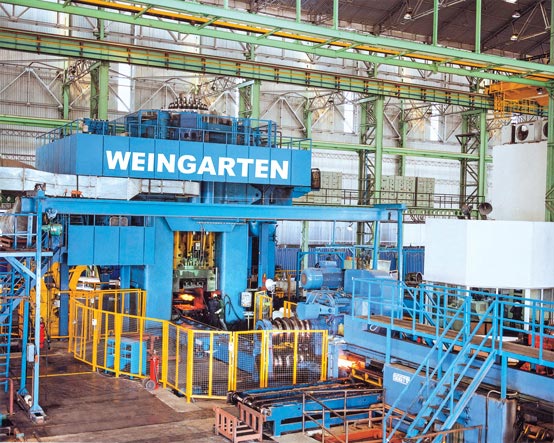
Installation of the state-of-the-art press in India enabled BFL to move from hammer technology to advanced press technology and transform from a predominantly India‑ focused Company to a global supplier with a significantly increased product portfolio and enhanced customer base.
Incurring significant capex of more than ₹1,200 million to shift from hammer technology to a more advanced press technology at a time when the Company had a turnover of ₹1,800 million was indeed a transformational decision that helped open the export markets to us in a big way.
"Opportunities multiply as they are seized."
– Sun Tzu
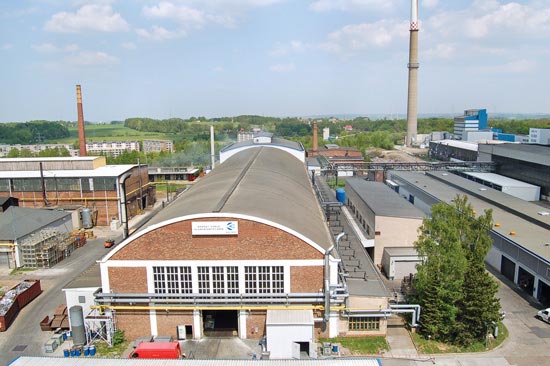
As a part of its strategy to increase its global footprint and to be an international player, BFL was aware it would have to proactively pursue international acquisition opportunities. Thus, in 2004, we acquired a German forging company called Carl Dan Peddinghaus GmbH & Co. KG. and CDP Aluminiumtechnik. In 2005, we acquired Federal Forge in Michigan, USA and Imatra Kilsta AB in Sweden as well as its subsidiary, Scottish Stampings Limited.
All the acquisitions had complementary production capacities, excellent market synergies, and were key suppliers to marquee global auto majors. These acquisitions gave us a strong customer visibility, geographical reach and a dual- shore supply capability that helped the Company become a global forging company in the real sense.
| 10 | 35 |
| 2004 | 2018 |

"Every skill you acquire doubles your odds of success."
– Scott Adams
From a growth opportunity and as a de-risking strategy, BFL focused on building an entirely new components business, with focus on major industrial segments in India and globally.
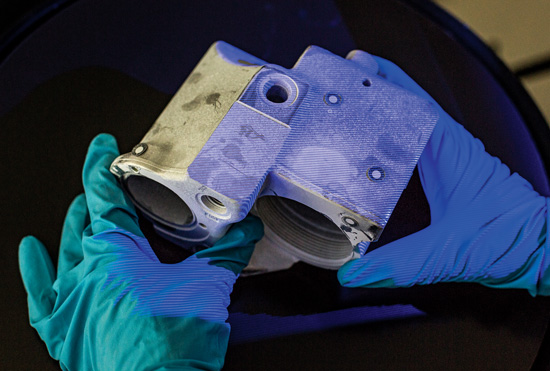
We set up a "Center for Advanced Manufacturing" at Baramati, Maharashtra, and also an open die forging unit at the existing facility in Mundhwa. This added around 100,000 MTPA to the Company’s forging capacity.
Embarking on setting up a one-of-its-kind facility dedicated to industrial sectors in India during the Global Financial Crisis (GFC) crisis helped us to create, deliver, and capture value in all these sectors when the eventual recovery took place.
"If I have the belief that I can do it, I shall surely acquire the capacity to do it even if I may not have it at the beginning."
– Mahatma Gandhi
BFL was always perplexed by India’s high dependence on defence equipment imports in spite of having strong indigenous capabilities. By leveraging its strong metallurgical expertise, advanced manufacturing facilities, and an innovative workforce, the Company developed a range of components and systems for import substitution.
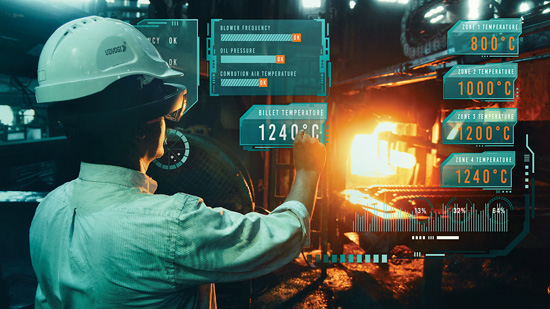
KCTI – our resolute commitment to innovation and R&D – has been the key enterprise capability that helped us achieve competitive advantage. It has performed a critical role in enabling the organization to find new ways to differentiate and compete. It facilitated our knowledge on new exotic materials and enabled us in new product development across sectors, while at the same time helping us to improvise on our present manufacturing processes.
"Learning & innovation go hand in hand. The arrogance of success is to think that what you did yesterday will be sufficient for tomorrow."
– William Pollard
The aim of the Company is to create an effective business transformation from the traditional products to a wide range of newly developed technologically advanced components and sub-systems. We intend to integrate and align our future strategic businesses with the existing business to differentiate and stay ahead in the industry as we pursue new innovation-driven opportunities that emerge and as we respond to shifting market demands. We strive to separate ourselves from competitors and establish a platform for future growth.
BFL focuses on two major aspects. Firstly, fostering an adaptive organisation that embraces new ways of delivering value and strengthening its existing competencies and secondly, continuing to evolve as new technologies arise and future technological disruptions take place.